



January 5, 2026
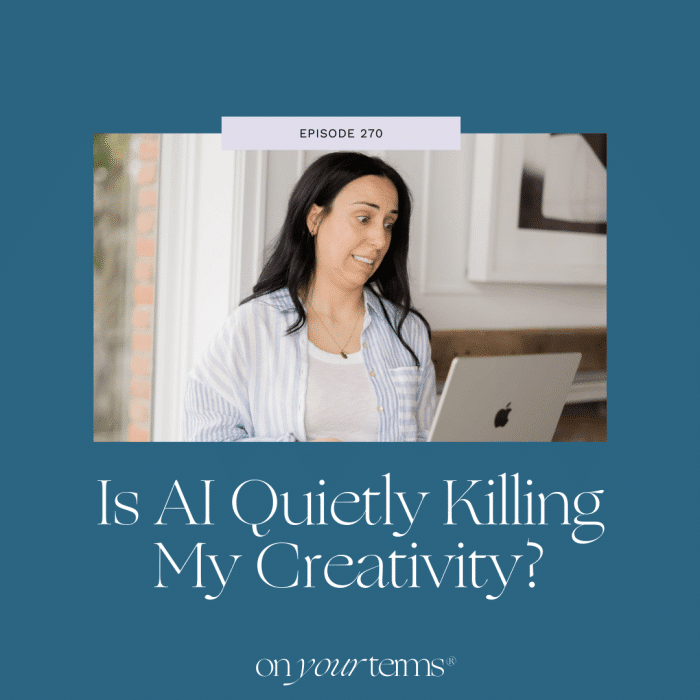
Is AI Quietly Killing My Creativity?
Listen on Apple | Spotify | YouTube
Listen Now:
Let’s talk about the thing I didn’t even realize was happening until it had already messed with my head: AI was quietly killing my creativity.
If you’ve ever opened your laptop, told yourself you’re “just getting a little AI help,” and then suddenly noticed your ideas feel watered down, your content feels off, and you’re second-guessing everything—you’re not alone. When I posted about this on Instagram, you confirmed that this little creep has been slipping into your business too… and not in the cute, helpful way we hoped.
So today, I’m getting brutally honest about how AI slowly started impacting my creativity, confidence, workflow, and even the way I approached this podcast. This episode is your reminder that your most valuable business asset is your brain—your original ideas—not a robot’s outline telling you how you should create.
Let’s talk about how this happened, how I pulled myself out of the AI spiral, and how you can reclaim your ideas, your voice, and your creativity in 2026 and beyond.
In this episode, you’ll hear…
- How AI slowly crept into my creative process without me realizing it
- The dangerous shift from “this helps” → “this must know better than me”
- How AI’s feedback made me doubt my instincts and dry up my idea well
- The moment I realized AI was contributing to a huge creativity block
- What happened when I quit using AI for outlines, brainstorming, and feedback
- The difference between using AI as a repurposing tool vs. as a creator
- The creative habits and practices I’m returning to in 2026
- How to rebuild your originality in a world obsessed with shortcuts
Listen to On Your Terms® on your favorite podcast platform
Listen to episode 270, follow along so you never miss an episode, and leave a review to help introduce the show to more online business owners just like you!
How AI quietly took over my creativity
In the beginning, I used AI the way most people do: to speed up tasks, help the team repurpose my original content, or summarize documents. Totally harmless. But then I started asking it to outline my podcast episodes… and the outlines it spit out were completely different from the ideas I had planned. The problem? I believed the robot over myself. That’s when the creep started.
The moment I stopped trusting myself
Somewhere along the way, I convinced myself AI knew the “right” angle and the “right” structure—like I was doing it wrong. I even asked AI to critique my marketing, my podcast strategy, and my business decisions. As someone normally confident in marketing, this messed with my head. Big time.
Suddenly, my idea well dried up. I felt frozen. I’d never experienced that before.
Why AI was slowing me down—not speeding me up
Contrary to everything AI promises, using it for idea generation was slowing me down. It made me question my instincts, delay episodes, rewrite content, and lose the creative thread that has always driven my business.
Once I realized all this started when I began outsourcing my creativity to AI? I stopped. Cold turkey.
Why 2026 is my Year of Creativity
This year, I’m doubling down on creativity, connection, and community. Not just talking about it—actually practicing it. I joined a pottery class. I’m writing more on Substack. I’m letting myself play, explore, and create without needing it to become content. (Although… let’s be honest, sometimes it still does).
Creativity is a muscle. And I’m strengthening it again.
Transcript:
Sam Vander Wielen: So based off of what you told me the other day on social media, you feel like AI is robbing you of your creativity. Initially, you might have turned to AI tools to help you to knock out some tasks inside your business, which is totally valid. But now AI is actually just slowing you down. It’s weakening your ability to think freely, and it’s totally robbing you of the creativity and joy that you once felt in your business.
In this episode, we’re going to talk about how I didn’t realize just how badly AI was killing my creativity and how it started to creep in, messing with my judgment, messing with my head, and frankly made my content suck for a while. So let’s talk about AI, what it’s really doing for us, and is it really helping us with our businesses and our creativity.
Welcome back to On Your Terms®, On Your Terms®, is a podcast for online business owners who want to be as present in their lives as profitable in their businesses. So before we get into this week’s episode, you know that lately on episodes, I’ve been pulling a question from this really cool stack of cards that I got completely randomly answering it on the spot, and I’m encouraging you to think about the question this week too. So, all right, here’s this week’s question.
What’s one thing you’re learning to like or just be more okay with? I’m gonna say uncertAInty because right now I’m just like I don’t know exactly what I want my next step to be and like exactly what I wanna do and exactly what I wanna write about next and instead of forcing it this year, my mAIn goal is just to surrender and see how it goes.
So speaking of creativity and creating content, I actually just came back from a week long trip to Chicago with my team where we went to Chicago to Kit Studios, they have insanely beautiful studios, by the way, in Chicago and in Boise, and we used the studios to refilm all of these um, kind of educational videos that are inside of the Ultimate Bundle®. That’s my signature program that gives people a pack of legal templates and trAInings to learn how to start an online business, by the way, it’s going on sale in a couple of weeks, so if you don’t already, make sure that you go down below click the link to sign up for my Sam Sidebar emAIls, because in those emAIls you’re gonna start hearing in a few weeks about something really cool. I have planned for you if you need the bundle, but I went there to shoot all of these and all of these videos had to be shot for the bundle. But one of the days that we were there, the third day actually, I sAId to the team like, I need to do something creative, right?
Like, yes, shooting. All of these educational videos are, you know, technically creative and I can try to be like crafty, but really they’re educational and they’re pretty strAIghtforward, especially given what I do, you know, legal stuff I’m talking about trademarks and copyrights and like there’s only so much of a sexy spin you can put on those kinds of things.
So I was really itching to create, which is actually how this episode came up funny enough, and weeks ago I had posted a reel on Instagram that just kind of surprisingly took off honestly, talking about this concept that I had kind of flirted with AI in the past and I started to see a really bad impact. It took off such a conversation online that clearly it deserves a bigger space, and that’s why I have this podcast so that we can talk more about this stuff in depth and have more nuance to our conversations. Because the truth is, when it comes to AI, these things are very nuanced.
Like I am not an AI hater. I am not an AI lover either. I don’t think it’s going to solve the world. I don’t think it’s the root of all evil necessarily. I have like a lot of maybe more like artist feelings that I would say are more emotionally driven, that it makes me really sad of what it’s doing to artists or what it’s doing to art and creativity.
But in general, I also understand that there are so many good uses for it as well. So just to frame our discussion today, when we are talking about AI and when I’m talking about what I think some of the more negative impacts have been and what I’ve seen it due to my creativity, and apparently you have as well, because you all piled on in droves in the comments, I am talking about the use of AI for original content creation.
So we’re talking about things like writing essays, you know, writing your newsletters, like creating beautiful works of art, right? People are using it to create pictures and art and videos and all kinds of things.
One of the things that’s been so helpful for, for us as a team is that I produce a lot of original content, right? What I consider to be cornerstone content, like this podcast episode, my weekly newsletters, my substack posts, things like that, right?
Well, there are are a lot of AI tools and, and cool things that AI can do to take my original words, the things that actually came from me, the ideas that came from me and the way that I put it. And it can turn those, those exact words and, and like concepts and ideas into assets that we can post in other places.
And the truth is that as a team of this, you know, size and the size of my business, like I would have to hire six social media people to be on all of the things. We’d have to be on LinkedIn and to be on Threads and to be in all of these places. And we we just wouldn’t be able to do that, right? It’s just too much.
So for us as a team, that’s, that is a way that it’s working for us and that’s helpful is to take my words, my original thoughts, and then we turn it into other pieces, especially on platforms that I’m not as passionate about. Like I consider LinkedIn to be more of like a placeholder, not necessarily a place where I’m hoping to grow and create a huge community and connection and all of these wonderful things.
So let’s talk a little bit and go back about how I think that over time AI kind of crept in and started to ruin my creativity. And I’m so curious to hear from you if you’re feeling similarly, or maybe if you found like a healthier balance at this point. I think that’s where my story has sort of ended up.
But first I wanna explAIn how we got here. So in the beginning I was so resistant to AI. I am one of those people that is just very resistant to like big trends. I am, I’m obsessed with cults. I like spend a lot of my free time reading about cults, watching cult documentaries, like doing all these culty things.
But I. I think one of the reasons why it fascinates me is because I am fascinated by the idea that like, when everyone’s like moving in this direction and, and like the whole herd is going over here, my instinct is actually to be like, I’m gonna move over here. Like, I’m gonna go in a different direction not to follow the herd.
And so. I’m very skeptical of and uh, kind of like resistant to when everybody gets really excited about things, especially when people use very like, bombastic language about stuff like AI’s gonna change the world and like all the jobs are gonna be lost and like everything is over. Everything’s changing, right?
So when everybody started talking about AI and then I started seeing all these people, like offering programs and all these things, all the ways it was gonna change your life, my skepticism antenna went way up. Right? And I think my old lady heels dug into like, I was like, you know, I don’t wanna do this.
This doesn’t sound fun to me. It’s kind of how I feel about TikTok. It’s just like, okay, cool, you guys go knock yourself out, like that feels so overstimulating to me. I’m like looking for less stimulation, like cozy, quiet, and I feel like sometimes like the world is like moving in a totally different direction than kind of where I want to go. And so that’s how I felt about AI.
Eventually, I couldn’t, I guess, outrun it in the sense that. I do see that there are helpful things that we as a team could do. Um, my friend Gemma Bonham-Carter for example, sells like all these really cool AI tools that help teams like mine to be able to run more efficiently.
Not to replace people on the team, not to like never hire someone again, but to actually help my team be more efficient in what they’re doing. To have my team be able to like really dip into more of what I’ve actually said and what I’ve created and run with it, right, and create assets from it.
So I started playing with that and I was like, okay, I see some uses here that are helpful, like the ones that I mentioned at the top of the episode. And so I feel like it started out innocently enough and I always had had from the beginning a hard rule with myself that I would not use and I was not interested in using, and I don’t want the team using aI to create original content that looks like it comes from me, right? Like my whole podcast episode or like creating scripts for me that are just from thin air, not from something that I have actually created or put input into, right? So I wasn’t having it write my emails. I wasn’t having it write substack posts.
But then I started doing this thing, and this is kind of where it all changed for me. I started asking it some suggestions about my podcast. That’s sort of where it started. I think that the goal behind it was innocent enough that, as I’ve mentioned here many, many times, like my big goal is to grow this podcast, and I want this podcast to get much bigger and reach more people and kind of with that goal in mind, I had had kind of reached a stagnant point in my podcast earlier last year where it wasn’t necessarily growing.
It had kind of been at the same place, and I was like, I don’t really understand what I’m doing wrong. I don’t understand what to do differently. Maybe AI will know. So when I would have an idea for an episode, I would say, Hey, ChatGPT, can you give me, uh, an outline for an episode where I’m going to talk about how AI kills my creativity, for example.
And then, as you know, you know, Chat or whatever, um, you use comes back and it gives you this big long outline, the suggested, you know, rubric of sorts of what you should talk about, the angle you should talk about. Because the team has even trained my chatbots to be based off of me. They’ve, they’ve followed all the trainings for the programs that we’ve bought.
It even spits out specific examples of my life. It will mention Hudson, my Bernedoodle, it will mention Ryan, my, my husband. It will mention the fact that I don’t eat red meat. Like its all these random things about me, right? And so when it would give me these outlines, it was so interesting because it would spit back an outline and I would be like, whoa, that’s completely different than what. I had actually planned, like I had a, a loose plan of what I had thought about the angle I wanted to take or kind of what I would’ve covered in the episode, but then it would give me this outline that would be totally different, and my reaction was, oh my God, I had it totally wrong. Like obviously it’s giving me the right answer.
It’s telling me how I should have, you know, approach this and right and pay attention to the, some of the verbiage here of right, and should, right? There’s like no right in this case, and there is no should. But notice the verbiage I’m using here, even using words like right and should are sticking out to me because there is no right way to cover a topic and there’s no way you should be covering a topic because really ideally, we should all be tapping into our creativity in order to do this.
So I started getting these outlines from it and obviously I had a choice at this moment. I could have chosen to get that and then say, oh, I’m going to go and do it my way anyway, right and I get that and that was, that was my choice. I think it’s important though, well I’m, I mean, I’m always honest as it is, but like I think it’s important to have this discussion because when I brought this up on social media, it seemed like a lot of you struggled with the same thing, where it’s almost like slowly but surely it kind of crept in and did this to you even without you maybe noticing or intentionally doing this and maybe it caught me in a vulnerable moment, right, where it’s like, I wanna grow this podcast. I felt frustrated that I had been trying to do that in the past, and it, and it hadn’t necessarily worked the way I wanted, and I didn’t understand what I was doing wrong.
So it can be kind of easy then when, whether it’s a business coach or an AI bot tells you like, this is how you should do it, right? Then I was like, well, maybe this is it. Right? Right. Like the, the fact that I would have done it so differently than what AI told me, I should have done it like, I started filling in the blanks of like, that’s why I’m not successful, because I’m not doing it like it’s telling me.
So I started saying, okay, let me, let me trust this. I mean, people are saying, this thing’s gonna take over the world. This is changing lives, right? This thing is so smart, so powerful. Okay, let me listen to this outline. Let me start doing this.
This is when I actually made an even more tragic mistake when it comes to AI. It’s when I started asking it for feedback on my podcast more globally, my business more globally, my marketing strategy and approach. Okay? As I mentioned here all the time, I would not consider myself to be a very confident person in ge in life in general. However, I’m pretty confident. Then I’m pretty decent at marketing and I started asking it for marketing feedback.
I was asking it like, what am I missing in my business? Where do you see the holes and why I’m not doing this, that, or the other thing. Where would you make a suggestion for me to change something about my business? What should my podcast be about if I wanted to grow like such open-ended, big questions that really no one can let alone should be telling you the answers to because you’re the one that has to do the work and you’re the one that has to show up and really this business, this creativity, entrepreneurship should be from a place of what you truly desire to put out into the world, the change that you want to make, the impact, the special thing, I think that you have to offer the special sauce right in your life. That’s what I think we really should be focused on, not what the computer is telling us to focus on.
Over time, all of this feedback started really getting in my head, and I noticed slowly but surely it had the very opposite effect of what I thought it would have. So I thought this thing was going to like fast forward my productivity and make shortcuts for everything in reality, actually really slowed me down because it messed with my head, it, I made me not trust my instincts. And then over time it actually dried up my well of creativity and ideas, which if you know me, is not something that I ever have dried up on before because I literally think about these things all of the time. And when I’m out and about, I just have a million ideas. . I have football, field length, uh, levels of ideas. And so for me, this was a huge like this is really different than what I’ve felt before that this thing started to creep in and actually just make me feel like, well, if it’s telling me that all my ideas are bad or it’s telling me that all this thing I thought about doing aren’t, is not the right way to go about it, then I guess I don’t know anything. And I just kind of felt frozen as to what to do.
I’m not sure if there was any sort of like pivotal moment here or why something shifted for me, but I think it had gotten so bad in terms of how I felt very different than myself. Like I didn’t feel creative and I didn’t feel like I had those ideas anymore, that I started to put two and two together to be like, you know what?
This all started when I started asking chat for input. This all started when I started asking for it to review my outlines or to create outlines for me or something like that. And so you know what I’m gonna do? I’m just gonna quit.
I still had that same goal and desire to seriously grow this podcast, but I knew that if I was going to do that, I was going to do it on my own terms that is why I named the show, what I named it after all. And so it just was like, I don’t know, a little bit of a reset that I needed a little slap in the face for myself to be like, go back to your roots. And so what are my roots? Well, for one, I have always been someone who’s drawn a lot of inspiration from what’s happening around me.
So whether that’s literally paying attention to every single thing I see, um, ’cause I can’t help it ’cause I’m between being both nosy and observant, I see everything that happens all around me all the time. So really paying attention to what happens around me that like in my business has led to the best fodder. Whether it ends up being the beginning of an emAIl, it ends up as a sales email. It ends up in a podcast episode somewhere, or a story I tell as a guest on somebody else’s podcast. Paying attention to what’s happening around me has been just like one of my biggest, I think, secrets as to being a creative person in the online business industry.
And funny enough, you can’t do that if your head is buried in a computer or if you’re expecting a computer or an AI algorithm to be the thing that is spitting that out for you, because at least as far as I know, ChatGPT doesn’t have experiences like of its own. So it doesn’t really, it’s not really able to tell you what’s going on in the world.
I also think the key to creating good content and growing a successful business is to pay attention to your customers. I don’t need chat to tell me what’s going on with my customers because I could just talk to my customers, wild idea. I know, but they’re right there. I don’t need to make any guesses. I don’t need to ask chat what I’m missing.
I don’t need to ask chat to analyze what’s in my customer’s heads. If they don’t know my customers, right? So this is a great example of how we, we actually do use something like AI, but not from an original standpoint.
So for example, every single quarter we interview a whole host of our customers that have recently purchased one of our products, and we get on Zoom, we record of course, with their consent, and we get the transcripts of those recordings.
We then take all of those transcripts from the recordings, pop them into something like chat, and we can synthesize and analyze the information from those interviews to pick up on trends. It’s one of the best ways I like using it because it can pull out commonly used phrases. Um, it can notice patterns in the fact that everybody says the same thing. Like, sigh of relief, for example.
Since we’ve been doing it now for a while, it can also start to pick up on trends over time. So, for example, seeing in my own business that in the last, um, I would say year or two, it has picked up on the fact that my customers now are much more focused on starting an online business the right way. That’s very specific language.
Whereas when I started back in 2016, 2017, we had so much more of a mixed bag, but had a lot of people who were just like, I started up this online business thing and now I’m freaked out that it’s not legit. It’s actually a very different mindset that people are in. So that’s a good example of how like that’s some a way that we use the tool, but I’m not asking AI straight up without any information like what do you think’s in my customer’s heads, like what should I be talking about? How should I put it? What are they worried about? I have that information from them. We do these calls, I read the transcripts, I watch the videos. So I am still at the end of the day like the gatekeeper and the synthesizer of that information.
I also always pay attention to trends and like obviously keep my eyes on the news with what’s going on given what I do with the legal side of online business. And more than anything, I keep a running list of all of these things that we are talking about. So whether it’s that I’m on the plane and the couple behind me is like really bizarre and somebody destroyed the bathroom and we couldn’t even get up to go to the bathroom. True story. That’s what happened on my way to Chicago, um, that made its way into the Story bank. Or if it’s the guy I see at the farmer’s market who hasn’t started his bakery yet, or it’s the fact that a friend isn’t getting a business off the ground. And I can see like the issue with why they’re not doing it.
I keep all of these things in a running list somewhere as well as all the things I pick up on from customers or I see, um, like a really interesting comment on one of our reels or something like that. So it’s a running idea bank.
So yeah, that was a sort of my foundation. That’s always what I’ve done and that’s always been a very successful way for me to come up, not only come up with ideas, but then actually create the content and so when I quit using AI for those kind of more, uh, creative processes or asking it for feedback, I just went back to that foundation.
Here’s one of the biggest issues I have with people being so interested in, in using AI. Like first of all, I think it’s so interesting that people are so worried about there being so many online businesses and like the space being so crowded, and I kind of see like platforms, like social media, for example, as being like a traffic jam and with AI, especially with it making it so easy to just like pump out random pieces of quote unquote original content, it’s now just like clogging the traffic jam. It’s just like throwing a ton more traffic into an already very congested area. And the problem is, is that most of the stuff that it’s getting clogged up with is really bad. It’s, it’s pretty bad quality. So it’s, it’s first of all destroying the whole place. Like where it’s like as if it was all clogged up with traffic and now nobody wants to drive through there anymore. So I do think this is tied to the fact that we are hearing from so many people that they don’t want to be on social media.
I feel like it’s, it’s just getting more and more popular that people are removing themselves from platforms, spending less time on those platforms. Engagement on pretty much every single social platform is significantly down.
Pretty much everybody I know is working on reducing their screen time, spending less time on their phones, being more present in their lives. I think this is for, for many, many different reasons and like we’ve probably just hit like peak technology screen time. But I also think that AI had kind of just accelerated this in that it’s just getting so wild online, like you don’t even know whether videos are real. There’s so much crappy content being put out that you’re like, well, what’s the point? People don’t even see my good content. It’s really frustrating.
We also, you know, I talk about this in my book a lot, but like we already have a sameness problem. We already have this problem in the online business world where people come in, they start an online business, they see somebody else who has a similar, uh, style business or like an adjacent one, and they’re just like, well, she does it like that.
So I’ll do it like that, and then that will make me successful. And so there’s already like an issue and a hurdle to a lot of originality and like original content creation. I think AI has just made that way worse.
You know, I mentioned earlier that AI, you know, it’s not a person, it doesn’t have original thoughts, feelings, experiences, you know, unique quirks or personalities, and so I do think it’s also very interesting, even as an entrepreneur, I think about this a lot, that like one of my responsibilities is to not rip off other people, other businesses, is why I’ve talked about dupe culture in the past. That’s why I’m like very careful. I’m not into dupes because I’m not into ripping off other people’s intellectual property, why I won’t buy things from companies like Quince, where they just like pump out products that are all just rip-offs of mostly small businesses. Um, and so I am very careful about that and I think about that a lot with AI, where AI, like, let’s not mistake it AI, these algorithms have been built off of the backs of creator’s original work.
This has been built off of people’s books, thoughts, ideas, words, videos, sounds, everything. Their art, mostly without their knowledge or permission, right? There have been a lot of lawsuits to this effect, and so when it, even when it is spitting out, just keep in mind when you’re like, wow, that’s so powerful that it can create that thing.
It is creating that thing based off of somebody else’s originality. It’s creating that based off of somebody else’s creativity. AI itself is not creative. It is taking that from a lot of different people. And when we all upload and contribute continued content, and I even think about this for my own use cases that I mentioned earlier, like this is a downside and this is a problem, and this is something that keeps me up at night.
But when we are even uploading our own content there, it’s like we’re just contributing. We’re like throwing into the pile. So now it’s taking my writing right? It’s taking my style, my uh, you know, even for like when I write about legal stuff, like I know it can turn around and it can send that to somebody else.
We don’t own the content. That it creates for us the stuff it spits out and this every single thing that you’re uploading can become part of the larger build of it.
So that’s more, I guess, to do with the idea of like why I don’t love the idea of being on it. But you know, it was sticking with my original topic here of like how I think it’s impacting my creativity. I do think it’s related actually, because as a creative person, I do think it’s really important for you to, I mean, not only support it with like with your values, like you’re a creative person, so I think we should respect other people’s creativity, but I also think it’s important that you keep developing that as a muscle.
And that this is something that, you know, the more that you give away, it’s like, it’s like AI is stealing this thing from you. That you have this incredible opportunity, in my opinion, to let the world know what you really think to share your unique and original talents to create your art. And the more that we turn tools like this where we think like this thing knows the answer, it knows what art should look like, it knows what photos should look like, it knows what our writing should sound like. It’s very dangerous, not only for the world as a whole, but it’s dangerous for us as a creative a group of people.
So I don’t know about you, but this is the top of 2026 here and I, this year especially am focused on creativity and connection and community. But I know that one of the things that I tend to do is I will, I don’t know, I maybe it’s like the perfectionist in me who kind of like research something to death and so I will think about being creative and talk about it and look into it and like watch a bunch of YouTube videos about other people who are really creative. But then I won’t actually put pedal to the metal. And so this year, i’m already in action as you’re listening to this, but this year I am much more focused on actually implementing my creativity. Some of it yes, will be for work and like part of that for me was detaching a bit from AI, from original content creation or brainstorming even to be like you know what? Let me like flex my own brAIn. I think I come up with enough ideas, let me play, let me learn why things work and why they don’t work, and get in touch more with my community and like my customers.
I don’t need this thing to tell me what to, to do in my podcast episode. And so let me play with that within my work, but also let me do this in, you know, my offline time, my, my personal life so that I come back to my work refreshed and feeling more creative.
For example, on the work side, this is one of the reasons why I write on Substack. If you don’t follow my Substack Beyond Business, um, already, I’ll make sure I leave the link down below for you to join. But I started Beyond Business because I wanted a place to write beyond my business, right and beyond things that are just strictly about business.
I’m really using the space to let myself play and practice. One of the things we’re gonna talk about next week, because a lot of people keep asking me, why are you on substack? Or like, what’s your strategy? Or are you like, why are you doing that? Plus your Kit newsletter, Sam’s Sidebar every week. So we’re gonna chat about that next week. But that’s sort of one of the places within my own business even that I give myself like a place to play. I think it’s really important to have whatever your focus is, like maybe yours is not writing, maybe it’s podcasting, or maybe it’s YouTube or being on TikTok or something like that. Right?
But I know I want to be a writer. I’ve already written a book and I want to improve my writing skills, and as I always say, writers write, so I, I gotta have a place to write. And so that’s the way that I think about substack.
On the personal side, I actually just signed up for a pottery course, which I’m so excited about and I’ve been wanting to do for so long. Um, so that actually starts in a couple of weeks. And so, yeah, and like not everything has to be even about business not everything has to necessarily come back to or become content or something like that, but I know that those are the things I’ll be exploring in 2026.
So I’ll leave a link down below to the reel that I posted on Instagram about this topic, because I know the discussion there was so good and I, I really encourage you to go and read everybody’s responses. It was so interesting hearing how AI is impacting everyone. But now I want to hear from you.
Now that you listen to this episode, I need you to go ahead and open up Instagram and send me a DM at samvanderwielen on Instagram or respond to any of my emails. I want you to reach out and tell me what you thought about this episode.
Did this make you realize that maybe AI is impacting you in a way that you hadn’t realized, or were you already feeling this way? Are you gonna consider it a little bit differently now? I’m just so curious. And I know agina, like I said, don’t come at me like I know that AI has its uses and some people feel really defensive about the fact that like it’s helping them in certain ways and that is fantastic.
I’m more, curious about talking with you about like how it’s impacted you as a creator, as the creative side of what you do and if you think you’re not creative like I used to because I can’t paint and all of my things look like stick figures. Um, think again because if you own an online business, you have come up with a very creative idea.
You literally participate in content creation. It’s right there in the name. And I bet you, you are very creative, whether it’s with the product or service that you’ve created or the way you go about it, or creating beautiful images or even creative on Canva, like you are creative, that’s why you’re here.
So, uh, I’d be so curious how you’re nurturing that going into 2026 and how you feel like AI does or doesn’t play a role. With that, thank you so much for listening and I can’t wait to chat with you next week all about substack and newsletters and how this is all fitting into the content ecosystem. I’ll see you then.
Thanks so much for listening to the On Your Terms® podcast. Make sure to follow on Apple Podcasts, Spotify, or wherever you like to listen to podcasts. You can also check out all of our podcast episodes, show notes, links, and more at samvanderwielen.com/podcast. You can learn more about legally protecting your business and take my free legal workshop, Five Steps To Legally Protect and Grow Your Online Business at Samvanderwielen.com and to stay connected and follow along, follow me on Instagram at samvanderwielen and send me a DM to say hi.
- Get Sam’s free weekly newsletter, Sam’s Sidebar
- Subscribe to Sam’s Substack Beyond Business
- Get Sam’s book “When I Start My Business, I’ll Be Happy”
- My Instagram Reel on quitting ChatGPT
- Listen to Episode 140. We Need To Talk About Dupe Culture
- Meet Your AI All Stars Course (affiliate link)
- Grab the Ultimate Bundle®
- Click here to be notified when new episodes of On Your Terms® come out
Connect:
- Get Sam’s weekly newsletter, Sam’s Sidebar, to learn how build your email list, protect your biz & grow an audience online
- Watch Sam’s Free Legal Workshop “5 Steps to Legally Protect & Grow Your Online Business” to learn exactly how to start an online business the right way.
- Follow Sam on Instagram
- Subscribe & follow On Your Terms®️on your favorite podcast platform!
- Subscribe to Sam’s Substack, where she shares behind-the-scenes of building a life offline, after growing a multi-7-figure business online
Free Legal Class:
Want to make sure you start your online business the right way? Save your seat in my free legal workshop “5 Steps to Legally Protect & Grow Your Online Business” here: GET MY FREE TRAINING
Sam’s Favorite Business Tools:
- Kit // what I use to build my email list, send emails to my list, and create opt-in forms & pages
- Kajabi // use Kajabi to sell your course, program, or even build your entire website. Get a 30-day free trial with my link.
- SamCart // what I use for my checkout pages and payment processing, and LOVE. And no, not because it’s my name.
AFFILIATE LINKS: Some of the links we share here may be affiliate links, which means we may make a small financial reward for referring you, without any cost difference to you. You’re not obligated to use these links, but it does help us to share resources. Thank you for supporting our business!
DISCLAIMER: Although Sam is an attorney, she doesn’t practice law and can’t give you legal advice. All episodes of On Your Terms® are educational and informational only. The information discussed here isn’t legal advice and isn’t intended to be. The info you hear here isn’t a substitute for seeking legal advice from your own attorney.
© 2022 Sam Vander Wielen LLC | All Rights Reserved | Any use of this intellectual property owned by Sam Vander Wielen LLC may not be used in connection with the sale or distribution of any content (free or paid, written or verbal), product, and/or service by you without prior written consent from Sam Vander Wielen LLC.
–
–
 0 Comments
![Sam Vander Wielen scrolling on her iphone. Text overlay reading "How I Stopped Doomscrolling and Started Watching This. [Summer Read-Aloud]"](https://www.samvanderwielen.com/wp-content/uploads/2026/08/How-I-Stopped-Doomscrolling-and-Started-Watching-This.-Summer-Read-Aloud-1024x1024.png)

So What Do you think?